How Knee Replacement Technology Has Evolved Over the Last Decade

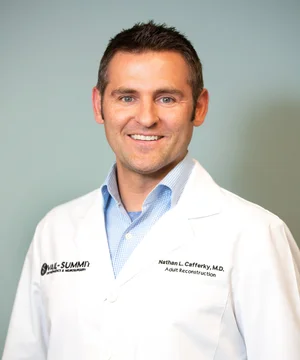
A Guide with Dr. Nathan Cafferky
At a glance
Knee replacement technology has shifted from standard implants to personalized solutions built around individual anatomy.
Robotic systems like ROSA® Knee improve surgical precision and real time decision making.
Smart implants such as Persona IQ® allow data driven recovery and remote monitoring after surgery.
Over the last ten years knee replacement technology has changed dramatically. What was once a mechanical procedure focused primarily on pain relief is now a highly personalized, technology driven solution designed to restore mobility, alignment, and long term performance.
Below Dr. Nathan Cafferky, board certified orthopedic surgeon and joint replacement specialist at The Steadman Clinic, explains how modern systems including Zimmer Biomet innovations are reshaping knee replacement for active patients in Eagle County and Summit County.
From Standard Implants to Personalized Fit
A decade ago most knee replacements relied on standardized sizing and mechanical alignment principles. While outcomes were strong, surgeons had fewer tools to customize implant positioning to a patient’s unique anatomy.
Today, Zimmer Biomet has advanced implant design with systems such as Persona IQ®. These implants are engineered with a broader range of sizes and configurations to better match individual bone structure and soft tissue balance.
As Dr. Cafferky explains, “No two knees are the same. Modern knee replacement technology allows us to match the implant to the patient rather than asking the patient to adapt to the implant.”
The Rise of Robotic Assisted Precision
One of the most significant advancements in knee replacement technology over the last decade is robotic assistance.
The Zimmer Biomet ROSA® Knee system is a robotic surgical assistant designed to support total knee replacement surgery. ROSA® collects data before and during surgery and provides real time feedback to help optimize implant placement based on the patient’s anatomy.
This does not replace the surgeon. It enhances surgical precision.
Benefits of robotic assisted knee replacement may include:
Improved implant alignment
Better soft tissue balance
More accurate bone preparation
Increased consistency in surgical execution
Dr. Cafferky says, “Technology like ROSA allows us to personalize alignment and make data informed adjustments in real time. That level of precision simply was not available ten years ago.”
Data Driven Recovery With mymobility®
The evolution of knee replacement technology does not stop in the operating room. Postoperative care has also transformed.
Zimmer Biomet’s mymobility® platform connects patients to their care team through an iPhone and Apple Watch. It provides exercise guidance, recovery milestones, reminders, and communication tools.
mymobility® allows patients recovering from knee replacement to:
Track progress
Receive personalized exercise programs
Communicate directly with the care team
Stay engaged and accountable during recovery
This level of connectivity helps streamline recovery and ensures that progress is monitored beyond traditional office visits.
The Smart Knee Era With Persona IQ®
Perhaps the most groundbreaking advancement in knee replacement technology over the last decade is the development of smart implants.
Persona IQ® is the world’s first and only smart knee implant granted De Novo status by the FDA for total knee replacement surgery. It combines the proven Persona implant with implantable sensor technology.
Persona IQ® measures:
Range of motion
Step count
Walking speed
Gait metrics
This data integrates with the mymobility® platform, giving both patient and surgeon valuable insight into recovery and functional performance.
What This Means for Patients Today
Over the last decade knee replacement technology has evolved in three key ways:
Greater personalization of implant design
Enhanced precision through robotic assistance
Real time recovery data through smart implants and digital platforms
For active mountain lifestyle patients who ski, hike, cycle, and travel, these advancements translate to:
More natural joint mechanics
Predictable alignment
Improved recovery guidance
Durable long term performance
About Dr. Nathan Cafferky
Dr. Nathan Cafferky is a board certified orthopedic surgeon and joint replacement specialist at The Steadman Clinic in Vail and Frisco, Colorado. As a leading knee replacement surgeon serving Eagle County and Summit County, he utilizes advanced Zimmer Biomet technologies including ROSA® Knee, mymobility®, and Persona IQ® to deliver personalized care tailored to each patient’s anatomy and activity goals.
If you are considering knee replacement surgery and want to understand how modern technology can support your recovery and long term mobility, contact Dr. Cafferky’s team at The Steadman Clinic today. Call 970-476-1100 or request a consultation online to take the next step toward moving pain free again.